RWA Index: How to Earn Yield on Tokenized Stocks
An RWA index is a basket of tokenized stocks that you hold as one token, and it earns you a fee every time traders swap between the stocks inside.

TL;DR
- Only about 14% of the $455M in tokenized stocks on Solana earns any yield.
- An RWA index holds 2 to 10 tokenized stocks as one LP token and earns a fee on every swap between them.
- 2 indexes are live: BigTech (6 stocks, 15 pairs) and xStocks5 (5 stocks, 10 pairs).
More than 1.5 million addresses on Solana now hold tokenized stocks, up from about 500,000 in June. Most of those stocks sit in wallets and earn nothing. An RWA index puts them to work.
What is RWA?
RWA stands for real-world assets. These are blockchain tokens that represent assets from traditional finance: stocks, government bonds, gold, real estate, private credit.
Tokenized stocks matter most for us. Take NVDAx: it’s a token that tracks the price of Nvidia stock. The issuer backs each token 1:1 with a real Nvidia share held by a custodian, a regulated company that stores the real asset. Holders don’t get voting rights, and the issuer reinvests dividends into the token instead of paying them out.
People hold tokenized stocks because they get:
- trading 24/7 on-chain, not only during market hours
- access from anywhere with just a wallet
- settlement in seconds
- use in DeFi: tokens can be lent, used as collateral or added to an index
How big are tokenized stocks on Solana?
- RWA on Solana grew from $700M to $4.3B in a year. That’s 26% of Ethereum’s RWA market, up from 4.5% a year earlier.
- Tokenized stocks on Solana grew from $63M to about $455M over the same period.
- Tokenized stocks on Solana traded over $12B on DEXs in 2026, as of early October.
Can you earn yield on tokenized stocks?
Yes, but few holders do. Of the $455M in tokenized stocks on Solana, a little over $65M earns any yield. That’s about 14%.
There are 3 main ways. You can lend them out on Kamino or Jupiter Lend and earn interest from borrowers. You can add one stock and USDC to a 2-token pool on a DEX like Raydium and earn fees on that one pair. Or you can put a basket of stocks into an RWA index and earn fees on every pair inside it.
This article is about the third way.
How does an RWA index work?
If you’ve ever added liquidity to a pool on Uniswap or Raydium, you already know most of it. On those DEXs you deposit 2 tokens, traders swap one for the other, and you earn a fee.
An RWA index holds from 2 to 10 tokenized stocks, and every stock can be swapped for every other one. You deposit once and get one LP token (LP stands for liquidity provider), which is your share of the whole index.
The number of pairs depends on the number of stocks in the index: n stocks give n × (n - 1) / 2 pairs.
- 2 stocks: 1 pair
- 5 stocks: 10 pairs
- 6 stocks: 15 pairs
- 10 stocks: 45 pairs
Which RWA indexes are live?
There are 2 RWA indexes on Coffer right now.
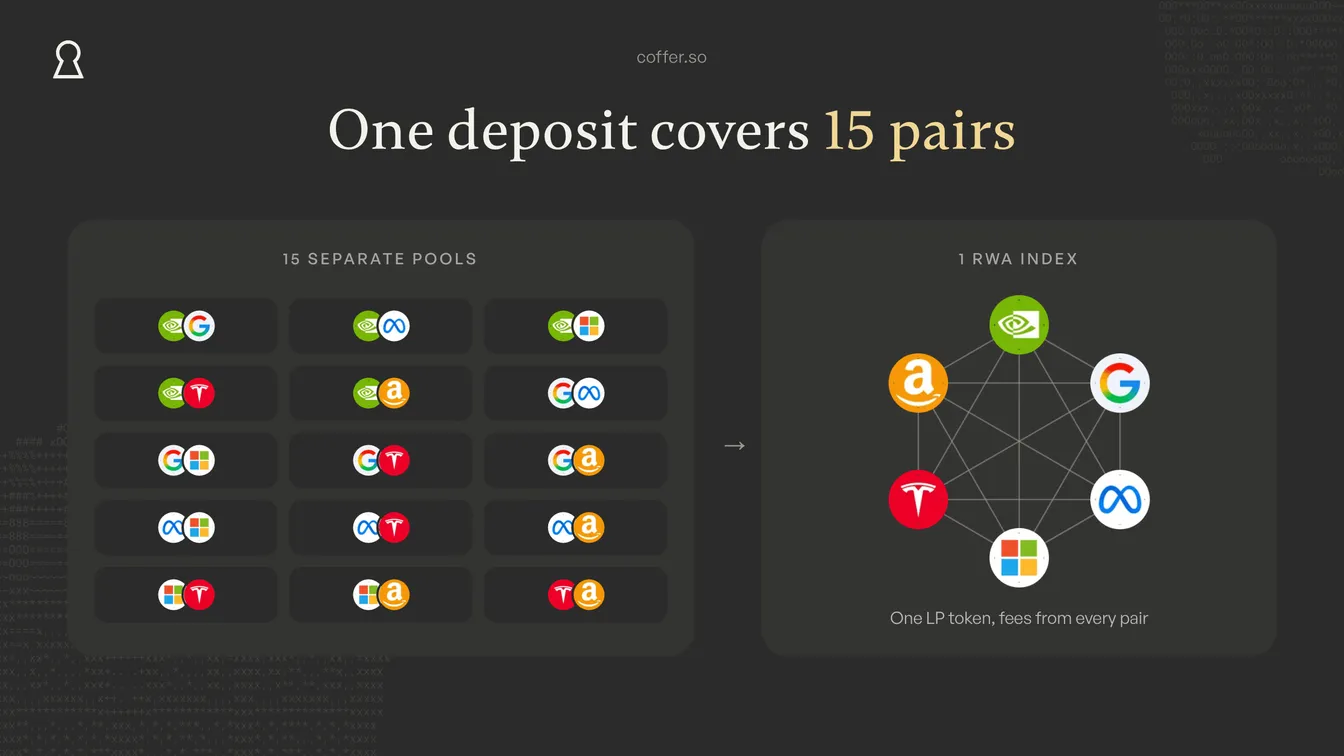
BigTech holds 6 stocks in equal parts: NVDAx, GOOGLx, METAx, MSFTx, TSLAx and AMZNx. That makes 15 trading pairs.
xStocks5 holds 5 stocks in different shares: NVDAx 30%, GOOGLx 20%, TSLAx 20%, MSTRx 15% and CRCLx 15%. That makes 10 trading pairs.
To get the same 15 pairs as BigTech with 2-token pools, you’d have to split your money across 15 pools and manage 15 positions. An index does it with one deposit.
Where does the yield come from?
The yield comes from swap fees. Every time someone trades one stock for another inside the index, they pay a fee, and it goes to the LPs. Two kinds of traders pay it: people who want to swap, say, TSLAx for NVDAx, and arbitrage traders who keep the index’s prices in line with the market.
Arbitrage volume comes from stocks moving apart. Say NVDA rises 3% on a day TSLA falls 2%. The index doesn’t watch the stock market, so for a moment it still sells NVDAx at the old, cheaper price. Traders buy the cheap NVDAx from the index and pay for it with other stocks until the index’s prices match the market again.
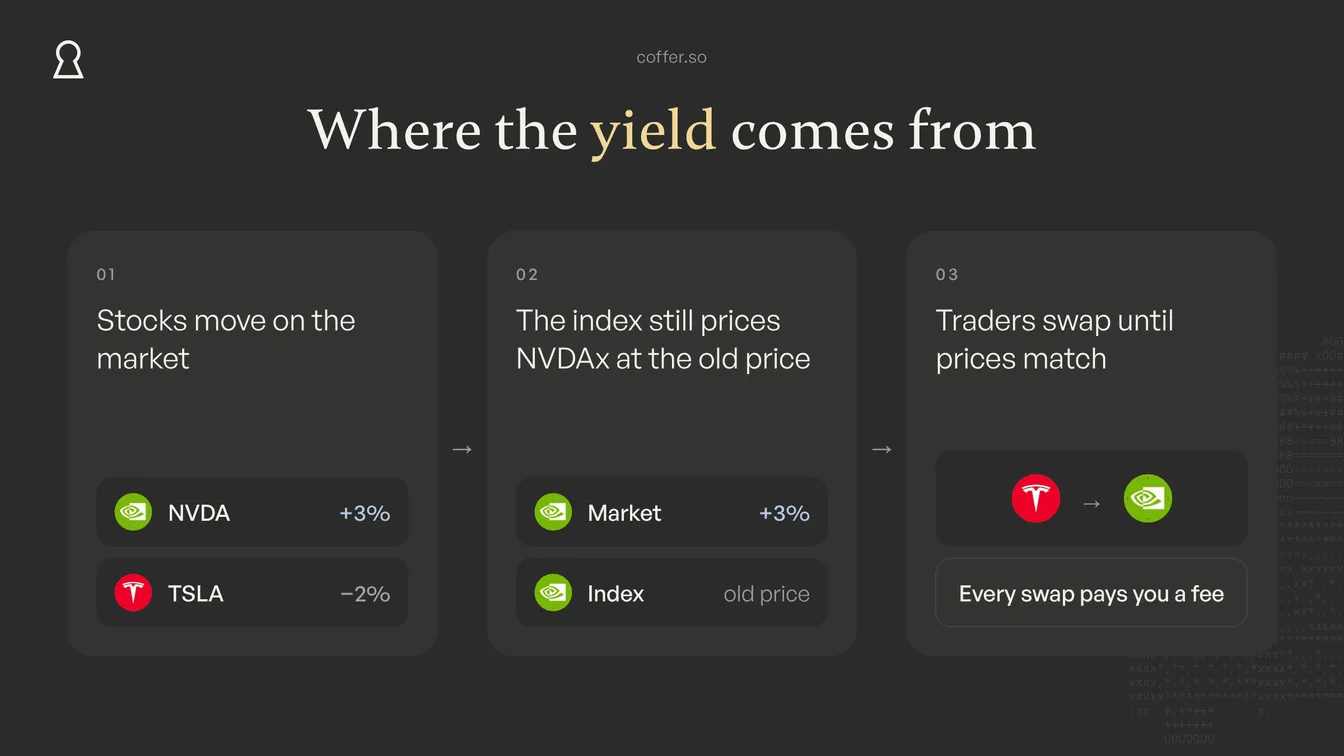
Each of those swaps pays a fee too. So your yield doesn’t need the stocks to go up. It needs trading: the more people swap and the more the stocks move against each other, the more fees the index earns, which is why the yield isn’t fixed.
Can I choose what goes into an index?
Yes. Anyone can build an RWA index and set 4 things.
The stocks. Any 2 to 10 tokenized stocks.
The weights. Each stock’s share of the index, from 1% to 99%, adding up to 100%. Equal parts like BigTech, or a tilt toward your favorite like xStocks5 with 30% in NVDAx.
The index keeps those shares in place. When NVDA rises, NVDAx grows past its share, so the index sells a little NVDAx to traders and takes in other stocks until the split is back where you set it. That’s how a constant-weight ETF works too. The S&P 500 Equal Weight Index, for example, resets its weights 4 times a year. To do that, the fund buys and sells stocks on the market, and the trading costs come out of the fund, so the people holding it pay for every rebalance. An RWA index works the other way around. It rebalances every time traders swap with it, and each of those swaps pays a fee to you, the holder.
If one stock keeps running far ahead of the rest, you end up with less of it than if you’d held it. That gap is impermanent loss, and the fees have to beat it. How big it gets depends on the weights you pick.
The Concentration Factor. Each stock gets its own factor, set against the index’s base stock. It works like concentrated liquidity on Uniswap v3: at a factor of 3, the index quotes that stock as if it held 3 times more of it, so each trade moves the price less. The trade-off is range. The higher the factor, the smaller the price move the index can handle before that stock runs out.
The swap fee. Whoever creates the index becomes its admin and sets the fee every swap pays, from 0% to 10%. The admin can change it later.
How do I try it?
- Open app.coffer.so and connect your wallet
- Pick BigTech, xStocks5, or create your own index
- Add liquidity
- Track your position in the app
RWA indexes run on a new version of the smart contracts that hasn’t been audited yet, and the app marks them with a flag. Until the audit is complete, providing liquidity to them, trading in them or creating new RWA indexes is at your own risk. All other pools remain on the audited version.
FAQ
What does RWA mean? RWA stands for real-world assets: things like stocks, bonds or gold, issued as tokens on a blockchain. Tokenized stocks are the RWA an index holds.
Is an RWA index the same as an ETF? No. An RWA index is a basket of tokenized stocks on Solana that earns swap fees. Nobody manages it for you and it isn’t a regulated fund.
How do I earn yield on tokenized stocks? Deposit them into an RWA index. Every time a trader swaps one stock in the index for another, part of the fee goes to you.
How many stocks can an index hold? From 2 to 10. Every stock in the index can be swapped for every other one.
Do the stocks have to go up for me to earn? No. The fee comes from trading volume: regular swaps between the stocks, plus arbitrage trades whenever prices move, in any direction.
Open BigTech or xStocks5, or build your own RWA index.
Sources
- S&P Dow Jones Indices: S&P 500 Equal Weight Index FAQspglobal.com
- TokenPost: Solana RWA market hits $4.3B, 26% of Ethereumtokenpost.com
- TokenPost: Solana tokenized stock holders pass 1.5Mtokenpost.com
- rwa.xyz: Solana RWA dashboardapp.rwa.xyz
- Crypto Briefing: Solana tokenized stocks pass $12B in DEX volumecryptobriefing.com